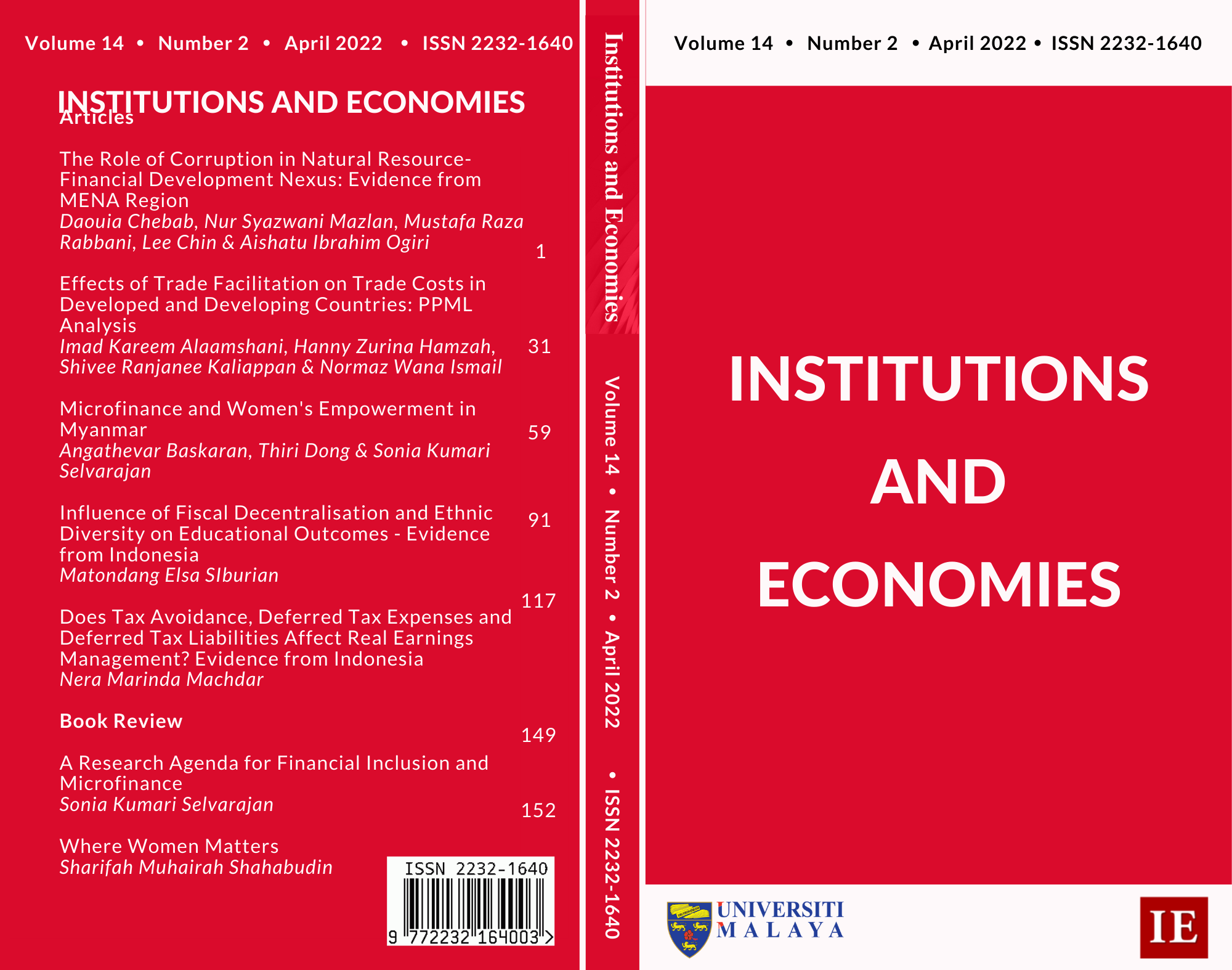
Microfinance and Women’s Empowerment in Myanmar
DOI:
https://doi.org/10.22452/IJIE.vol14no2.3Keywords:
Microfinance, Microcredit, Myanmar, Pact Global Microfinance Fund, Women’s empowermentAbstract
Like in many other developing countries, microfinance programmes in Myanmar have become an avenue to reduce poverty. This research examines whether microfinance in Myanmar has empowered female clients compared to non-microfinance clients, in terms of: (i) general decision-making (children’s education, family planning, children’s marriage, health care); and (ii) financial decision-making (income utilisation, loan usage, savings, investment). Primary data was collected using a questionnaire survey to achieve the research objectives. The sample of the survey consists of two groups of women living in the Ayeyarwady region, Myanmar: (i) Beneficiaries of microfinance programmes, and (ii) non-beneficiaries of any microfinance institutions. Female clients either started a new business or expanded/diversified an existing business using microfinance, which helped to increase income and savings. Overall, 89.8% of microfinance clients have gained significant empowerment (in making general and financial decisions combined). The discriminant analysis based on four indicators - children’s education, children’s marriage, savings, and investment - shows that the decision-making power of microfinance clients has improved compared to non-clients. The government should actively promote a microfinance ecosystem through robust microfinance institutional frameworks including, microfinance institutions, intermediaries, and local government agencies. Financial literacy awareness campaigns should be organised frequently to promote wider women’s participation in microfinance programmes.
Downloads
Published
Issue
Section
License
Submission of a manuscript implies: that the work described is original, has not been published before (except in the form of an abstract or as part of a published lecture, review, or thesis); that is not under consideration for publication elsewhere; that its publication has been approved by all co-authors, if any, as well as tacitly or explicitly by the responsible authorities at the institution where the work was carried out. Transfer of copyright to the University of Malaya becomes effective if and when the article is accepted for publication. The copyright covers the exclusive right to reproduce and distribute the article, including reprints, translations, photographic reproductions, microform, electronic form (offline and online) or other reproductions of similar nature.
An author may self-archive the English language version of his/her article on his/her own website and his/her institutions repository; however he/she may not use the publishers PDF version which is posted on www.ijie.um.edu.my. Furthermore, the author may only post his/her version, provided acknowledgement is given to the original source of publication and a link must be accompanied by the following text: The original publication is available at www.ijie.um.edu.my.
All articles published in this journal are protected by copyright, which covers the exclusive rights to reproduce and redistribute the article (e.g. as offprint), as well as all translation rights. No material published in this journal may be reproduced photographically or stored on microfilm, in electronic database, video disks, etc., without first obtaining written permission from the publishers. The use of general descriptive names, trade names, trademarks, etc., in this publication, even if not specifically identified, does not imply that these names are not protected by the relevant laws and regulations.
The copyright owners consent does not include copying for general distribution, promotion, new works, or resale. In these cases, specific written permission must first be obtained from the publishers.