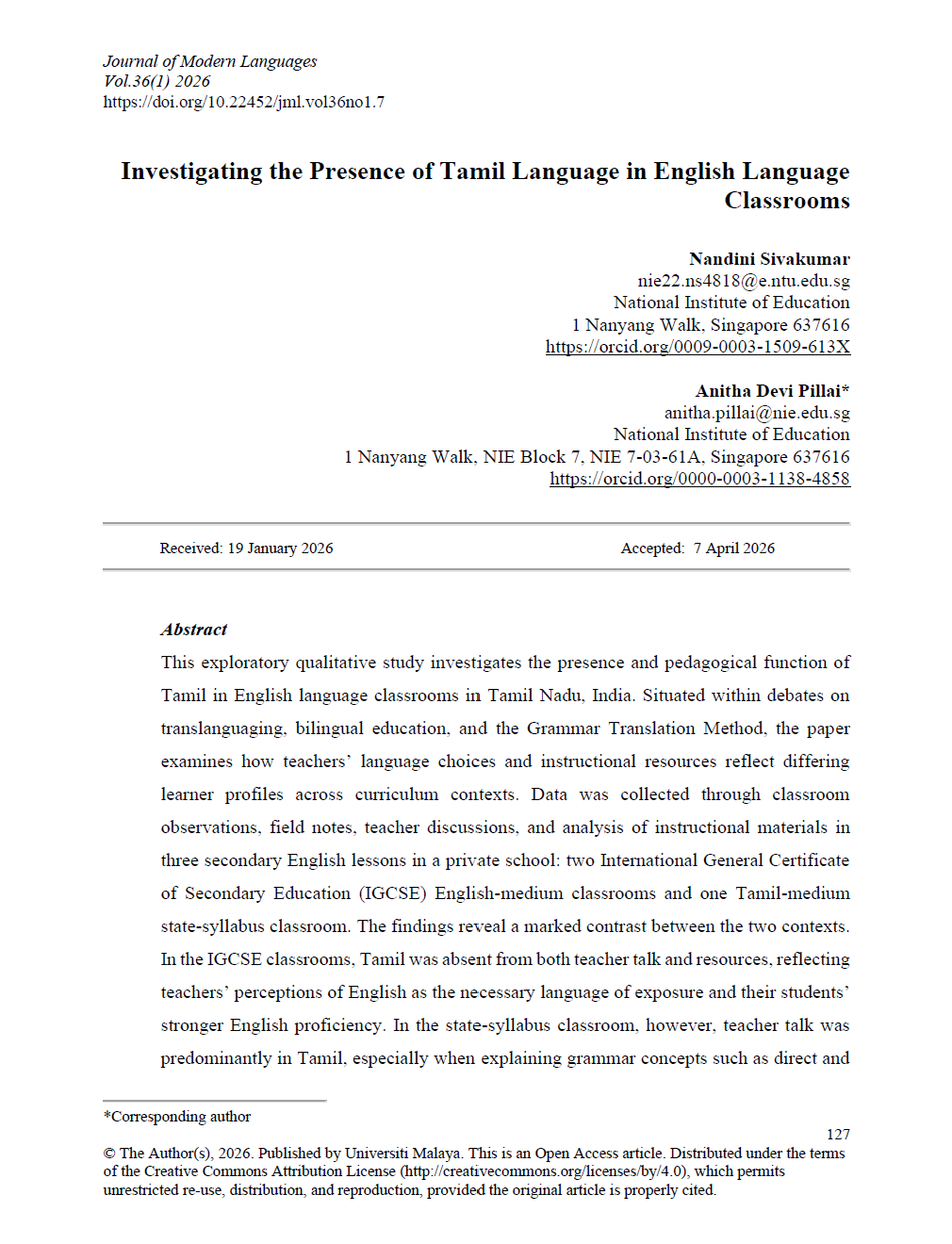
Investigating the presence of Tamil Language in English language classrooms
DOI:
https://doi.org/10.22452/jml.vol36no1.7Keywords:
Bilingual Education, Grammar Translation Method, Learner Needs, Tamil, Tamil-Speaking Classrooms, TranslanguagingAbstract
This exploratory qualitative study investigates the presence and pedagogical function of Tamil in English language classrooms in Tamil Nadu, India. Situated within debates on translanguaging, bilingual education, and the Grammar Translation Method, the paper examines how teachers’ language choices and instructional resources reflect differing learner profiles across curriculum contexts. Data was collected through classroom observations, field notes, teacher discussions, and analysis of instructional materials in three secondary English lessons in a private school: two International General Certificate of Secondary Education (IGCSE) English-medium classrooms and one Tamil-medium state-syllabus classroom. The findings reveal a marked contrast between the two contexts. In the IGCSE classrooms, Tamil was absent from both teacher talk and resources, reflecting teachers’ perceptions of English as the necessary language of exposure and their students’ stronger English proficiency. In the state-syllabus classroom, however, teacher talk was predominantly in Tamil, especially when explaining grammar concepts such as direct and indirect speech, while published resources remained entirely in English. The study argues that translanguaging practices in these classrooms are shaped less by broad policy positions than by teachers’ perceptions of learner needs, students’ home literacy practices, institutional norms, and uneven bilingual proficiency. It proposes a spectrum of translanguaging practices, ranging from separate bilingualism to explicit translanguaging pedagogy, to account for the observed differences. The paper concludes that Tamil can function as a valuable scaffold for English learning when used purposefully, but its role must be understood as context-sensitive rather than universally applicable across Tamil-speaking educational contexts.
Downloads
Published
License
Copyright (c) 2026 Nandini Sivakumar, Anitha Devi Pillai

This work is licensed under a Creative Commons Attribution-NonCommercial 4.0 International License.